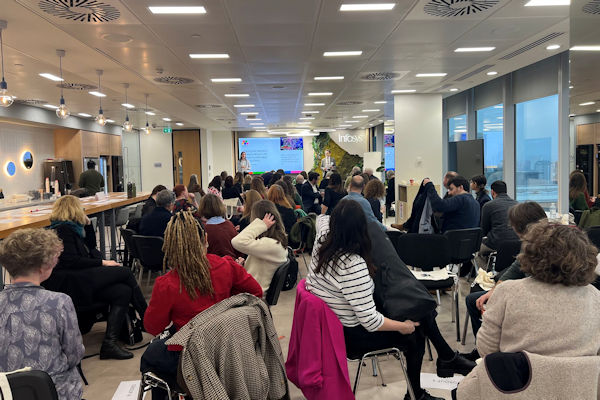

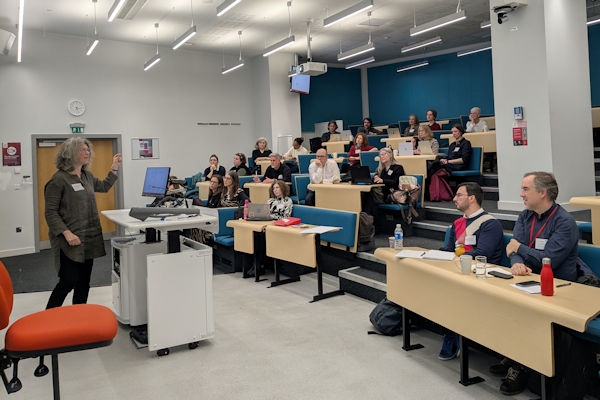
How can MILA add value, as a coordinating and enabling charity, to the media and information literacy (MIL) environment in the UK? This was the broad question considered at a stakeholder event organised by MILA at City St George’s, University of London, on 16 January 2025. The purpose of the gathering was to explore the prospects of partnerships for future activities facilitated by MILA. We wished to initiate discussions with potential partners to bring about concrete ideas for collaborative projects proposals relevant to media and information literacy.
The event brought together 35 participants from around thirty organisations, representing a good range of sectors – academia, education, librarianship, media and policy.
Click for list of participants
The event opened with a scene-setting introduction from Sonia Livingstone, Professor of Social Psychology, Department of Media and Communications at the LSE, who gave us an overview of how the MIL environment, and attitudes to it, has changed over the past twenty years; and of the challenges faced by policymakers in the implementation of measures to address MIL.
Click for Sonia Livingstone’s presentation
The major part of the meeting was dedicated to workshop sessions where participants considered ideas for MILA to take forward collaboratively. Below is a summary of the suggestions that emerged, categorised under type and timescale of activities.
Short term initiatives – quick gains
Two initiatives may be realistically actioned over the next 2-3 months, at no cost:
- Online forum: MILA’s existing channels of communication (website, quarterly newsletters sent to our mailing list plus occasional announcements, social media presence on X, BlueSky and LinkedIn) are essentially one-way. There is a strong case for using a platform that allows for cross-sector dialogue, awareness-raising and crucially, for community building. There was a consensus that Basecamp is a good tool for this; we can set up an account in the coming weeks and publicize its existence through our networks.
- Submission to school curriculum review: for the first stage of the review last autumn, MILA submitted a broad and fairly generic response to the call for evidence. This was drawn up in consultation with a range of key, relevant players, many of which submitted very detailed and technical responses. The review is expected to produce an initial draft report, which will be open to consultation around February-March. Following this, MILA should adopt a different approach from the first stage and draw up an overarching response in the form of a statement that stakeholders can then sign up to. This would have the advantage of (i) making the response more credible and (ii) allowing MILA to demonstrate its role as a collaborative agent. To help in this process, MILA should organise a webinar inviting would-be signatories to frame the response (depending on the timing of the review process, this online event might need to be organised at short notice). MILA might also consider polling for views through e.g. Survey Monkey.
Recurring / ongoing activities
MILA could develop a distinctive role through running a programme of ongoing/rolling activities, although it should be recognised that the extent of such a programme depends on human and financial resourcing. A few examples were suggested during discussions:
- Regularly sharing information about relevant funding opportunities.
- Developing communities of interest through organising in-person events, perhaps modelled on the 16 January workshop. The rationale for this is that there are limits to what can be achieved solely through online engagement and there is therefore a place for face-to-face interactions. We might consider charging small participation fees to help meet organisational costs.
- Engaging in advocacy, lobbying and/or campaigning, including media awareness campaigns, to provide a collective, credible voice for getting key MIL messages across, perhaps with a focus on a given theme over any year. The Change4Life public health campaign was suggested as an example that MILA could draw from.
Medium to long term initiatives and projects
Some of the ideas below are vague and/or tentative and it was recognised that securing funding is inevitably a challenge. Nevertheless, they provide possible paths to explore during the course of 2025 and beyond.
- Undertaking a wide-ranging, systematic research-based evaluation or meta review of the impact of MIL on levels of attainment, to help inform public policy.
- AI is an inescapable factor and MILA could usefully undertake work to help develop awareness of the relevance and applications of AI and/or the impact of AI on critical thinking abilities. There is growing academic interest in the concept of AI literacy, so it is timely to look, in an evidence-based way, at the intersection of AI and MIL, and of AI education- not just gen AI, but AI more broadly (e.g. in the way that AI influences algorithms, the relationship between AI and intellectual property, AI transparency for users, etc). MILA activities in this area could perhaps include horizon-scanning on how AI affects relevant sectors. We should bear in mind that Ofcom is delving into these sorts of questions too.
- Development of different evidence-based tools that are easy to use and importantly, engaging and attractive, with the following suggested examples:
- An AI tool, maybe in the form of a chatbot, which could be presented as a ‘MIL assistant’, to provide guidance and support on MIL in a transparent way. Such a tool could be used to support aggregation of ‘good information’, with focus on adult skills.
- Apps focused on very practical, everyday deployment of MIL, for instance to help people ward against online scams.
- Development of games, with a fun element, to help promote understanding of MIL, also for everyday situations.
- A tool or framework, geared especially to small providers, to advise on compliance with the Online Safety Act.
- Setting out a knowledge base, a one-stop shop for different groups (young people, parents, teachers, practitioners such as librarians, etc.) of what works well in MIL, providing an overview of the MIL landscape.
- Accreditation, whether formal or informal, is an issue which has come up in MILA conversations over the past year, and it was raised again at the meeting. It remains unclear what it could mean in practice, other than generally serving as a framework to recognise MIL skills, perhaps using badges. It was suggested that any such framework might be geared more to functional skills than to criticality.
- Supporting teachers and librarians, through advice/guidance on upskilling for MIL pedagogy, particularly in the context of the implementation of the curriculum review.
General principles
When developing any of the above activities, MILA should consider some underlying principles:
- The respective needs of young people and their parents, and the relationship between them, is an important driver for MIL initiatives.
- The importance of working with public-facing bodies that have a wide social reach, for instance community groups, charities and libraries.
- Reaching audiences that are particularly vulnerable to mis/disinformation.
Funding
The event did not delve to any extent into funding opportunities and, other than Ofcom, none of the dozen invited funding bodies took part. But there was a general view that MILA should be imaginative about which organisations it engages with and potentially seeks funding from – for instance social media platforms, mainstream media outlets and the gaming industry.
What we should avoid
There was agreement that MILA should not become a membership organisation. Going down that route would undermine our ethos as an open forum and a community/alliance of interested parties. It might also be perceived as exclusivist. Though membership could potentially bring in income through fees, any financial benefits would be outweighed by the these downsides.